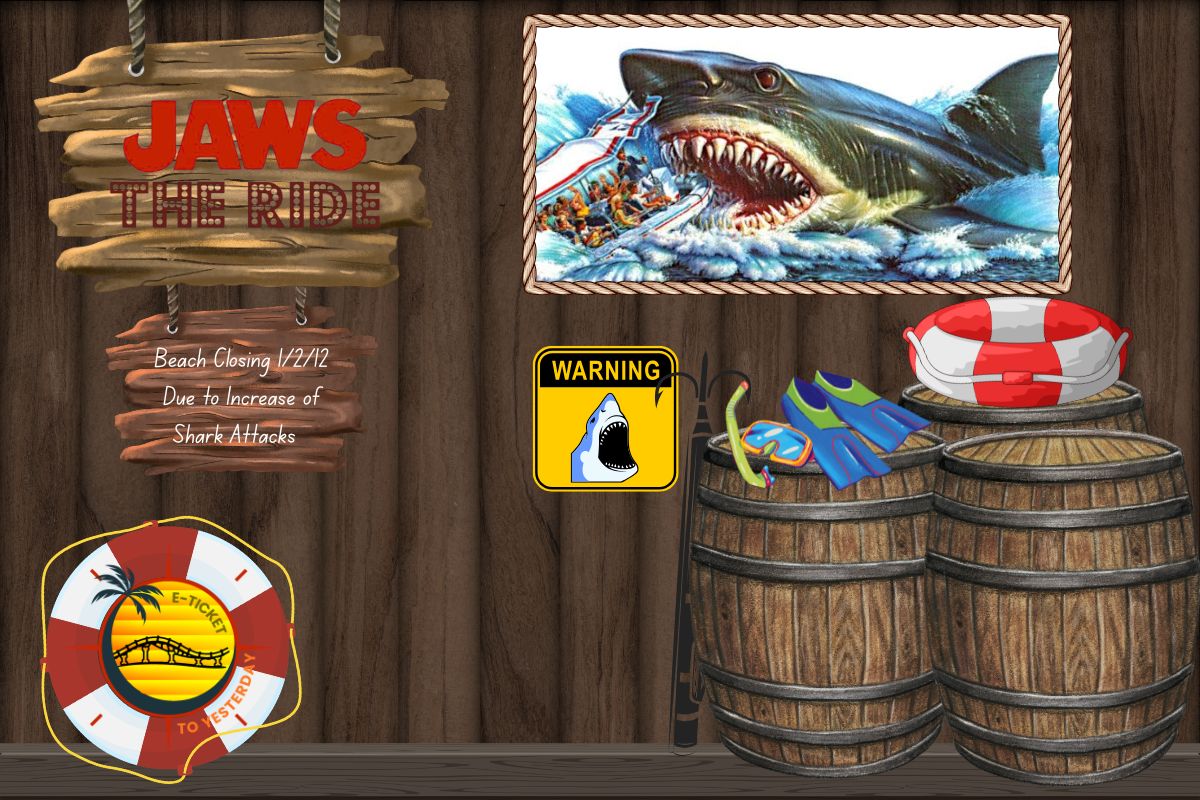
When Universal Studios Florida opened in 1990, one attraction promised to place guests directly into one of the most iconic films ever made. Instead of simply watching Steven Spielberg’s 1975 blockbuster “Jaws,” visitors would board a sightseeing boat through the quiet waters of Amity Island – only to find themselves hunted by a 25-foot great white shark.
Although plagued by technical problems during its opening year, “JAWS: The Ride” would eventually become one of Universal Orlando’s most beloved attractions. After a complete redesign, it entertained millions of guests for nearly two decades before closing in 2012 to make way for The Wizarding World of Harry Potter – Diagon Alley.
Today, the attraction is remembered not only for its suspense and spectacle but also as one of the most ambitious theme park attractions ever attempted.
Bringing the Big Screen to a Theme Park
During the late 1980s, Universal was preparing to open Universal Studios Florida, a new theme park that would combine working film production with attractions based on some of the studio’s most recognizable movies.
Few films represented Universal Pictures more than “Jaws.”
Already featured as part of the Studio Tour in Hollywood, the mechanical shark known as “Bruce” had become synonymous with the studio. For Orlando, however, Universal wanted something much larger. Rather than simply passing the shark, guests would become part of the story.
The attraction’s original concept was developed by Peter Alexander, who worked alongside Steven Spielberg and MCA President Sidney Sheinberg during the park’s design. Alexander originally envisioned the shark encounter as one scene within a much larger water attraction. However, Universal executives believed the film deserved an attraction of its own, ultimately leading to the creation of an elaborate boat ride based entirely around the events of “Jaws.”
Welcome to Amity
Rather than recreating the film scene for scene, Universal built an entirely original experience.
Guests entered Captain Jake’s Amity Boat Tours, a fictional sightseeing company operating in the peaceful seaside town of Amity. The queue was designed to resemble a working marina complete with fishing equipment, weathered docks and props from the “Jaws” films. Guests passed Chief Brody’s jacket, Quint’s fishing rod and even two screen-used boats from “Jaws: The Revenge” – Neptune’s Folly and the Amity Police Boat.
Televisions throughout the queue played a fictional local broadcast from WJWS Channel 13, featuring tourism advertisements, news reports and programming celebrating Amity’s recovery from the infamous shark attacks of 1974.
Every detail helped convince guests they had stepped into a functioning New England fishing town before boarding their tour boat.
A Troubled Opening
Universal Studios Florida officially opened on June 7, 1990.
Unfortunately, “JAWS” was not ready.
Although the attraction opened alongside the park, it immediately suffered from severe technical problems. The ride relied on enormous hydraulic shark animatronics, moving tour boats, synchronized special effects and underwater electronics operating simultaneously in Florida’s harsh outdoor environment.
Within months, Universal closed the attraction, citing mechanical difficulties. Behind the scenes, the problems proved even more significant.
Universal later filed a lawsuit against Ride & Show Engineering, alleging that underwater ride components had not been properly waterproofed, resulting in repeated equipment failures. Industry estimates suggested Universal ultimately spent nearly $70 million between the original attraction and its complete redesign.
Rather than abandoning the project, the company made the unusual decision to rebuild the attraction almost entirely from scratch.
Rebuilding Bruce
Universal partnered with Totally Fun Company, ITEC Entertainment, Intamin and Oceaneering International to redesign the attraction while preserving much of its original layout. Several major scenes were completely reimagined. The original sequence in which the shark grabbed the tour boat and spun it 180 degrees was removed because of its mechanical complexity. In its place came the now-famous gas dock explosion sequence.
Likewise, the attraction’s original finale – based directly on the ending of Spielberg’s 1975 film – was replaced. Instead of firing a grenade into the shark’s mouth, guests witnessed the shark bite into an electrified underwater cable connected to a damaged power barge, loosely inspired by the ending of “Jaws 2.”
The rebuilt attraction underwent three months of technical rehearsals, allowing more than 500,000 guests to experience the ride before its official reopening in late 1993.
This time, the attraction performed reliably.
Building the Shark
Although guests simply saw a giant shark attacking their boat, the technology behind the attraction was remarkably sophisticated.
The ride featured several hydraulic shark animatronics capable of swimming through the lagoon at speeds approaching 20 feet per second. Universal stated the hydraulic thrust powering the sharks generated force comparable to that of a Boeing 727 jet engine.
Creating the sharks’ appearance proved equally challenging.
Universal hired Kinetix to develop flexible latex skins stretched over massive hydraulic steel frames. During testing, engineers discovered the moving mechanisms repeatedly tore the sculpted gills from the skins. Rather than redesigning the internal machinery, artists painted the gills directly onto smooth latex, dramatically improving durability.
Programmers also spent countless overnight hours fine-tuning the attraction’s movements. Because the boats could not reverse, adjusting a single movement early in the ride required operators to complete the entire six-minute attraction before testing another change. The rebuilt version also featured elaborate practical effects, including synchronized lighting, fog, water cannons and one of the largest propane fire effects ever used in a theme park attraction.
Final Voyage
Following its successful redesign, “JAWS” became one of Universal Studios Florida’s signature attractions. In 2005, however, rising fuel costs led Universal to operate the ride only seasonally because of the large amount of propane required for its fire effects. Guest response prompted the attraction’s return to year-round operation in 2007, accompanied by several refurbishments that included freshly painted boats, updated shark skins and improvements throughout the queue.
By the early 2010s, however, Universal Orlando Resort was expanding once again.
To make room for The Wizarding World of Harry Potter – Diagon Alley, Universal announced that “JAWS” would permanently close. Fans flocked to the attraction during its final weeks, with many riding multiple times to say goodbye. The final public voyage departed at 9 p.m. Jan. 2, 2012, led by veteran skipper Michael “Skip.”
By the following morning, construction walls surrounded Amity. Within months, the entire land had been demolished.
Legacy
Although Amity disappeared from Universal Studios Florida, pieces of its history remain. The attraction’s famous hanging shark photo opportunity was relocated to the park’s San Francisco area, where guests can still pose beneath it today. Meanwhile, “JAWS” continues operating at Universal Studios Japan, allowing new generations of guests to experience Captain Jake’s boat tour.
Today, “JAWS: The Ride” is remembered as much for its engineering challenges as its storytelling. Its troubled opening, complete redesign and eventual success demonstrated Universal’s willingness to rethink and rebuild one of its most ambitious attractions rather than abandon it.
For many longtime visitors, the sight of a great white shark emerging from the waters of Amity remains one of the defining memories of early Universal Orlando. More than a movie adaptation, “JAWS: The Ride” became a landmark in theme park history – proving that sometimes the most memorable attractions are the ones that survive their own near-extinction.