
When EPCOT Center opened in 1982, it was envisioned as a celebration of human achievement, innovation and imagination. While the park’s attractions emphasized education and technology, Disney soon realized guests were looking for something that balanced learning with entertainment.
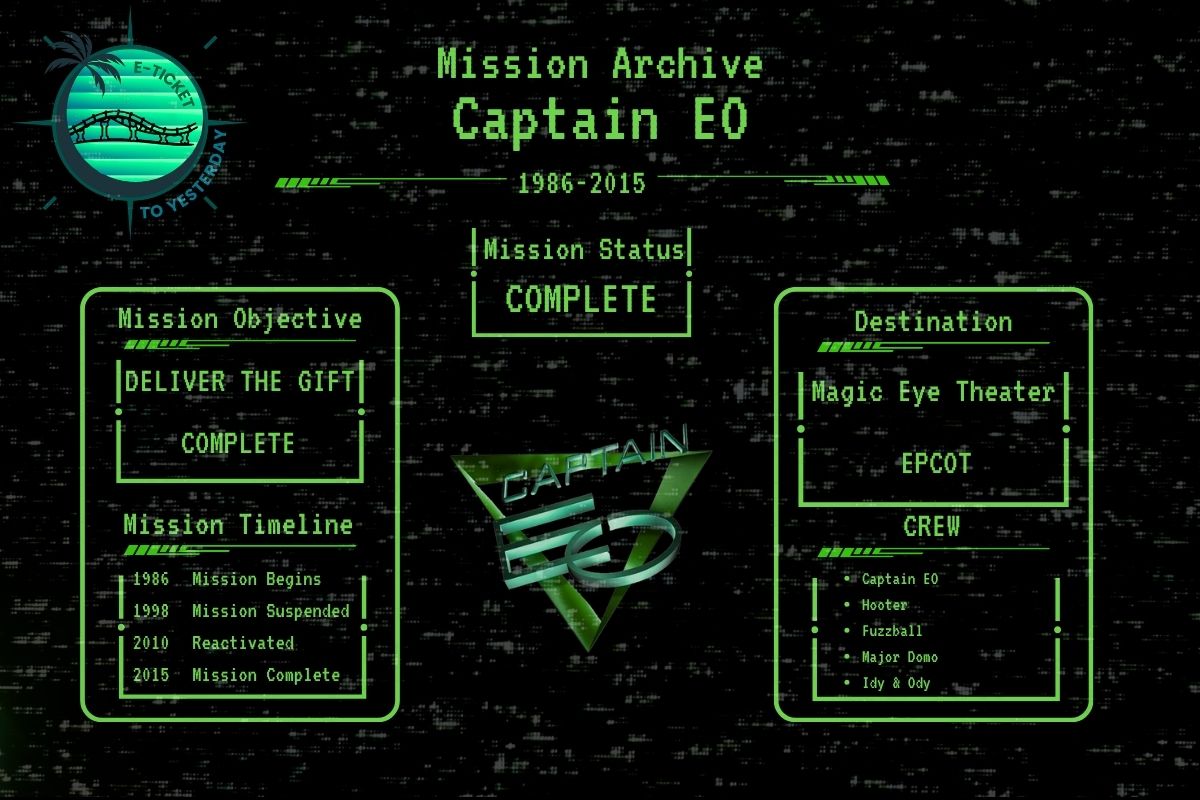
That opportunity arrived in 1986 with the debut of “Captain EO,” a 17-minute 3D science-fiction musical starring pop icon Michael Jackson. Combining Hollywood filmmaking, groundbreaking theater effects and one of the biggest celebrities in the world, the attraction became one of the most ambitious productions Disney had ever created.
For nearly a decade, “Captain EO” redefined what a theme park film could be before disappearing – only to make an unexpected return years later.
A Park in Transition
When EPCOT Center debuted on Oct. 1, 1982, it looked very different from the Disney parks guests know today. Rather than focusing on Disney characters and traditional attractions, the park centered on science, technology, world cultures and the possibilities of the future.
Inside the Journey Into Imagination pavilion, guests found “Magic Journeys,” a whimsical 3D film exploring imagination through the perspective of a child. Housed inside what would later become known as the Magic Eye Theater, the attraction reflected EPCOT’s original philosophy of inspiring guests through abstract storytelling and visual artistry. Although “Magic Journeys” showcased impressive 3D technology for its time, attendance throughout the park failed to meet Disney’s expectations during its early years.
Executives recognized that while guests appreciated EPCOT’s educational focus, many also wanted experiences that felt more exciting and recognizable. Rather than abandoning the park’s mission, Disney chose to enhance it with a production that blended education, technology and entertainment on a much larger scale.
The Birth of Captain EO
To create its next attraction, Disney assembled one of the most accomplished creative teams in entertainment. The project was executive produced by George Lucas, creator of the “Star Wars” franchise, directed by Academy Award-winning filmmaker Francis Ford Coppola and starred Michael Jackson, who was at the height of his worldwide popularity following the release of “Thriller.”
The result was “Captain EO,” a 3D musical science-fiction adventure created exclusively for Disney theme parks.
With an estimated production budget of approximately $30 million, the attraction became one of the most expensive films ever produced on a per-minute basis.
“Captain EO” officially opened at EPCOT on Sept. 12, 1986, replacing “Magic Journeys” inside the theater.
Pushing the Limits of Theme Park Technology
Although “Captain EO” lasted only 17 minutes, it introduced guests to an experience unlike anything Disney had previously attempted.
The attraction combined a stereoscopic 3D film with synchronized in-theater effects that would later become known as a “4D” experience. As the story unfolded, seats moved in sync with the action while lasers, smoke, fog, lighting effects and bursts of air immersed guests in the adventure. Fiber optic lighting transformed the theater ceiling into a star-filled sky, helping create the illusion of traveling through outer space.
While these effects have since become common in modern attractions, they represented cutting-edge technology in 1986 and helped blur the line between cinema and theme park entertainment.
A Story Told Through Music
The attraction followed Captain EO and his crew as they traveled to a dark industrial planet ruled by the Supreme Leader. Rather than defeating their enemy through combat, Captain EO transformed the lifeless world through music, dance and creativity.
The film featured two original Michael Jackson songs, “We Are Here to Change the World” and “Another Part of Me,” which served as the centerpiece of the attraction’s story.
Although the narrative itself was relatively simple, the combination of music, choreography, visual effects and in-theater technology created an experience that became one of EPCOT’s defining attractions during the late 1980s.
The End of an Era
By the early 1990s, however, technology had continued to advance, and audience expectations had changed. What once felt revolutionary increasingly reflected the style and production trends of the 1980s. Attendance gradually declined, and Disney looked to once again reinvent the Magic Eye Theater.
In 1994, “Captain EO” closed at EPCOT.
Later that year, the theater reopened as “Honey, I Shrunk the Audience!,” a new 4D attraction starring Rick Moranis reprising his role as inventor Wayne Szalinski from Disney’s “Honey, I Shrunk the Kids.” Like its predecessor, the attraction featured moving seats and environmental effects, but emphasized comedy rather than musical spectacle.
For many guests, this marked the end of “Captain EO.”
An Unexpected Return
Following Michael Jackson’s death in 2009, Disney announced that “Captain EO” would return to EPCOT as a tribute to the late performer.
The attraction reopened in 2010 largely unchanged, although several original theater effects had been removed during the conversion to “Honey, I Shrunk the Audience!” years earlier. Even so, longtime fans embraced the opportunity to experience the attraction again, while younger audiences saw it for the first time. Disney described the reopening as temporary, and after nearly five years, “Captain EO” closed permanently on Dec. 6, 2015.
The theater has since hosted several preview presentations for upcoming Disney films before becoming home to the Disney and Pixar Short Film Festival, which continues to operate in the space today.
Legacy
Although “Captain EO” existed for less than a decade during its original run, its influence extended well beyond the Magic Eye Theater. The attraction demonstrated that theme park experiences could combine Hollywood filmmaking, popular music and physical theater effects into a single immersive production. It also represented one of the earliest examples of Disney partnering with major entertainment figures outside the company to create an attraction built specifically for its parks.
Today, “Captain EO” remains a nostalgic favorite for many guests who experienced its blend of music, technology and spectacle during EPCOT’s formative years. While the theater has continued to evolve, the attraction’s legacy lives on as one of the most ambitious and influential productions in Disney theme park history.