
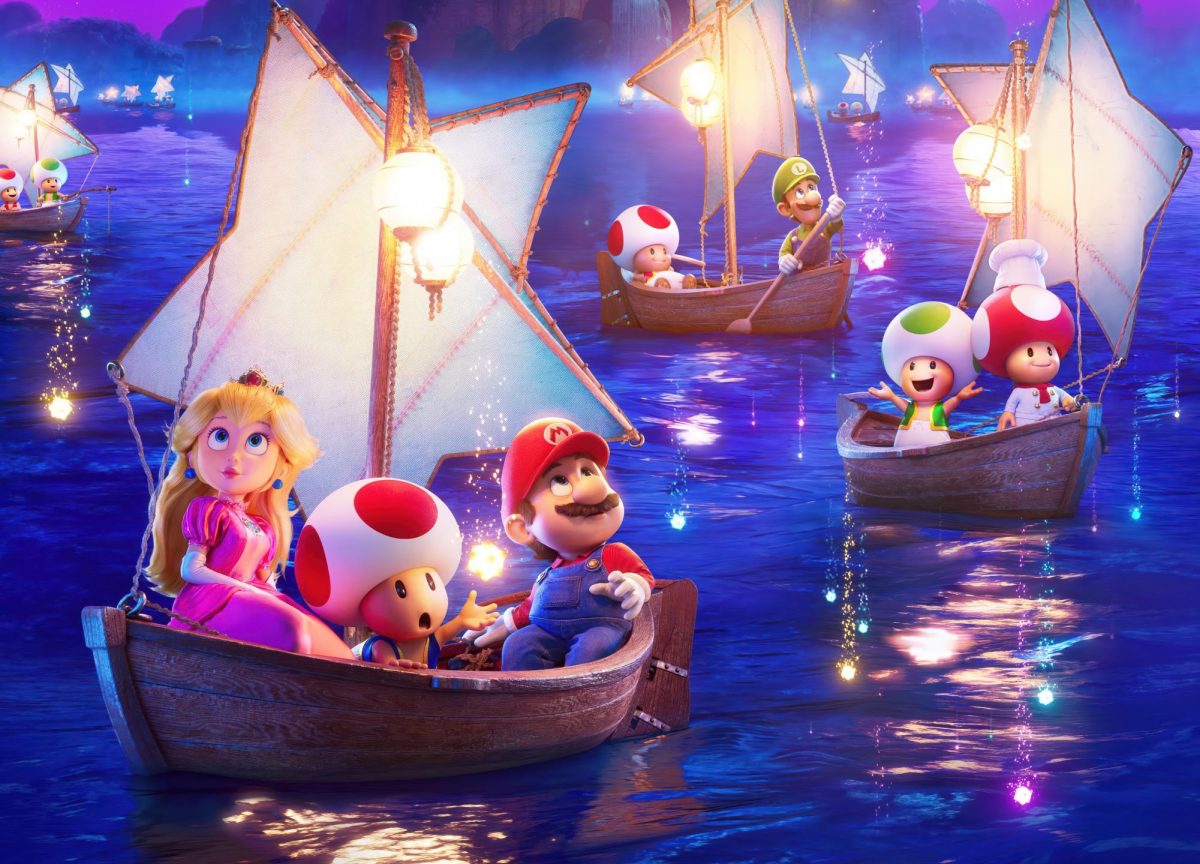
On April 1, Universal released “The Super Mario Galaxy Movie” by Nintendo and Illumination. The film is a sequel to 2023’s “The Super Mario Bros. Movie,” an adaptation of the iconic video game franchise by Nintendo. The story follows the titular hero and his friends on a cosmic journey to rescue the mysterious Princess Rosalina from the clutches of Bowser Jr.
While the first film was a box-office juggernaut and generally well-received by audiences, it was critically panned. “Galaxy” seems to be following in these exact footsteps, currently holding a 42% on review aggregate site Rotten Tomatoes, against an 89% audience score and a $372 million opening weekend.
The general consensus seems to be that, while the film is weak in story, it’s nevertheless an audiovisual treat for Mario fans. And maybe that’s all it had to be. After all, the Mario games, while beloved, aren’t known for their storytelling. Nor was this film’s predecessor, for that matter. And as a Mario fan myself, I did find the movie enjoyable.
But this film is not just the second Mario movie. As the title suggests, it positions itself specifically as an adaptation of 2007’s “Super Mario Galaxy” and 2010’s “Super Mario Galaxy 2.” These entries are often considered the crown jewels of the mainline series, critically renowned for their innovative level design and gravity mechanics. But they are also known for their surprisingly cinematic qualities. The first game, in particular, has a largely ethereal, quiet atmosphere and a story with emotional depth. As such, the potential for a film adaptation seemed far greater to many fans.
Tragically, however, “The Super Mario Galaxy Movie” carries none of the artistic soul found in its game counterpart. While certain story beats are familiar and iconography from “Galaxy” and “Galaxy 2” appear on screen, more crucial aspects are either changed, sidelined or downright ignored.
The biggest difference can be found in the story of Rosalina, portrayed here by Brie Larson. The character was introduced in the first “Galaxy” game, acting as the caretaker of the game’s hub world, the Comet Observatory. While a supporting character, she had a backstory told in storybook form that served as the game’s emotional spine. It dealt with themes of loss, death and family, rivaling the best of Pixar in terms of family-friendly emotional depth.
The movie throws that story in the trash, replacing it with what felt like a generic ripoff of Disney’s “Frozen.” Granted, the change isn’t completely illogical. The new story gives Rosalina more importance to another character while also paying off a scene from the first Mario movie. Unfortunately, the pacing is too fast to explore any greater depth or relationship between the two characters, failing to earn the emotional payoff it strives for. It additionally does not explain Rosalina’s place in the present-day as a caretaker to the Lumas, which was the primary function of the game’s storybook. It feels both unsatisfying in the context of the film and insulting to the source material.
The rest of the story is an unfortunate mixed bag that doesn’t reach the highs of its source material or its film predecessor. The film starts with a fairly strong first act that roughly follows the opening of the first “Galaxy” game. The second act, while a diversion from the original story, is very fun but starts to falter in depth. Everything then comes together for a horribly rushed conclusion that left me thinking, “Wait, that’s it?” when the credits rolled. In many ways, it almost felt like I had just finished watching a TV special instead of a cinematic movie. That’s not something I felt about the first film, despite its flaws.
Visually, however, the film is breathtaking. Following in the footsteps of its predecessor, it faithfully brings the Mario universe to life in rich detail. In the rare moments when the movie does try to adapt the visual tone of the “Galaxy” games, it excels at it. There’s a moment early in the story that recreates an iconic sequence from the first game, where candy-like Star Bits rain down over the Mushroom Kingdom. The team at Illumination managed to make the scene even more magical in a way that only animated cinema can accomplish.
Accompanying the visuals is an excellent score by returning composer Brian Tyler. Many iconic tracks from “Galaxy’s” exceptional soundtrack are remixed here, alongside very solid original compositions. While I was disappointed that some of my favorite, more emotional tracks from the “Galaxy” games were left out, Tyler’s work is an overall musical delight.
The entire cast is also excellently characterized and a joy to watch. The story begins to water the seeds of Mario and Peach’s relationship, including awkwardly funny moments when Mario makes romantic stumbles. Yoshi, portrayed surprisingly faithfully by Donald Glover, is cute as ever on the big screen, with a hilarious introduction. Bowser Jr. and his father also have a comedic yet very heartwarming relationship.
A major high point was the introduction of supporting character Fox McCloud, portrayed by Glen Powell. Fox is the protagonist of Nintendo’s “Star Fox” series, having only appeared alongside the Mario cast in the “Super Smash Bros.” fighting games. While his role in this film was unusual, it had a bombastic, meta energy reminiscent of the “Spider-Verse” films and “The Lego Movie.” It made me wish I were instead watching a Smash Bros. film that leaned fully into a crossover premise with that tone. In many ways, it would be a better match to the filmmaking style on display here than the story of the “Galaxy” games.
Despite this, Fox’s inclusion arguably took away chances to better adapt the source material. His role as a pilot that transports the main cast between locations could have easily been given to Lubba, the captain of the starship hub world from “Super Mario Galaxy 2.” Not only would that have provided more representation to the second “Galaxy” game – which is barely acknowledged in this film outside of some minor cameos and its main power-ups featuring – but it could have also provided more connection to the main plot thread of rescuing Rosalina, whom Lubba has a connection to in the game.
The film is full of missed opportunities similar to this. The plot contains many action set pieces, but virtually none of them are taken from the levels in the “Galaxy” games. It instead opts to reference other Mario and Nintendo games. While there’s no issue with taking more from the wider universe, it often feels like the “Galaxy” games are the least respected entries in their own movie.
Ultimately, “The Super Mario Galaxy Movie” offers fun, animated Mario content. But it fails at being a good movie and isn’t as coherent as its predecessor. And it most certainly is not worthy of bearing the title “Super Mario Galaxy.”
If you’re already a Mario fan, I would recommend it on the basis that you’ll likely find enjoyment here, even if it’s nowhere near as good as the games it’s based on. If you aren’t familiar with the source material, I would advise you to drive past the theater to your nearest game store and purchase “Super Mario Galaxy + Super Mario Galaxy 2″ for the Nintendo Switch instead.