For generations of visitors to Disney’s Animal Kingdom, a time-travel mission to the age of the dinosaurs was a rite of passage – equal parts science lesson and sensory overload.
Known today as “DINOSAUR,” the attraction opened in 1998 under a far more ominous name: “Countdown to Extinction.” Its story is one of corporate synergy, creative re-calibration and, ultimately, changing park priorities.
Now, Let’s Go Get That Dino
When the Animal Kingdom theme park debuted on April 22, 1998, Disney billed it as a theme park dedicated to real, ancient and imaginary animals. Dinosaurs, though extinct, fit neatly into that vision.
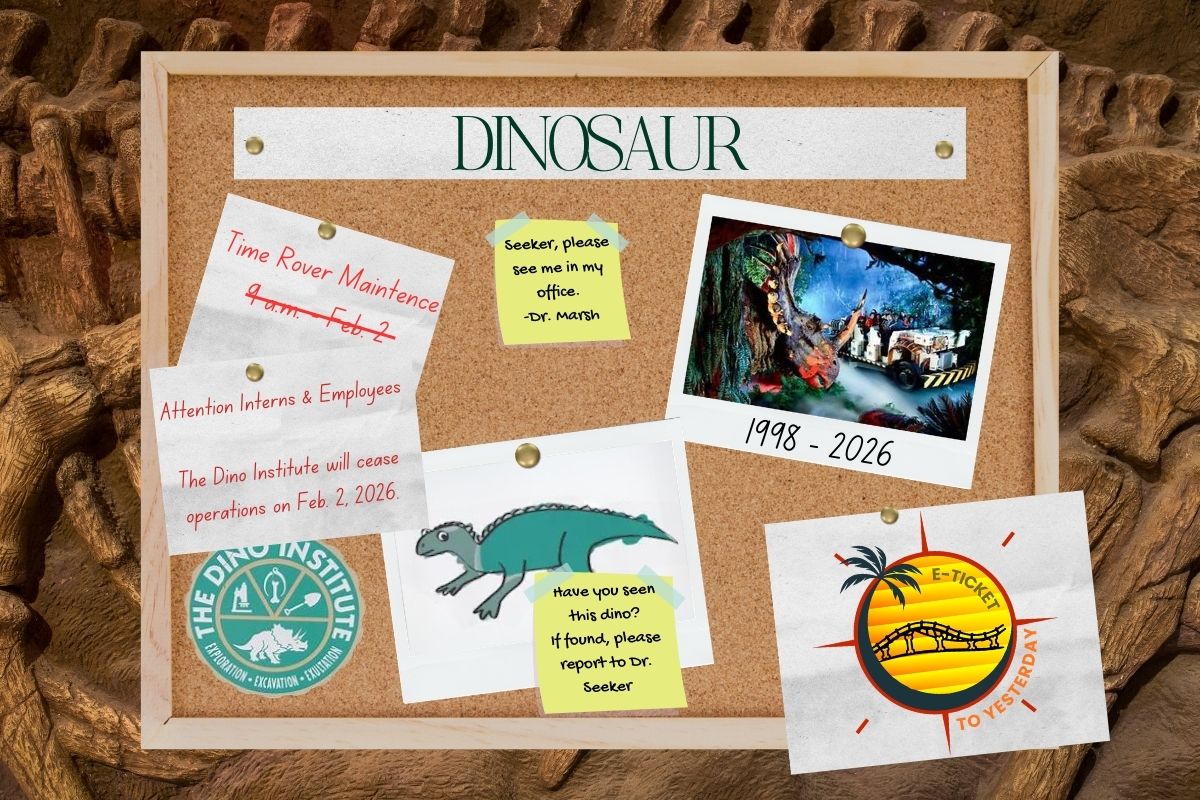
“Countdown to Extinction” was part of DinoLand U.S.A., a deliberately eclectic corner of the park blending playful, offbeat exhibits centered around a faux-scientific research facility known as the Dino Institute. The attraction’s queue introduced guests to a mix of fossil displays, interactive learning stations and a pre-show that set the stage for the ride: a high-stakes mission to save an Iguanodon from a catastrophic asteroid strike. Led by the eccentric Dr. Grant Seeker, visitors learned they were part of a unauthorized mission to transport the dinosaur safely through time – a narrative that combined humor, science fiction and adventure, giving riders a sense of purpose amid the chaos of speeding through the Cretaceous period.
The ride system – officially known as the Enhanced Motion Vehicle or EMV – was originally brought over from the Indiana Jones Adventure attraction in California’s Disneyland. Both attractions used the same track layout, but Countdown to Extinction leaned harder into darkness, sudden movements and jump scares.
DinoLand U.S.A. and the Beastly Kingdom Gamble
In the early planning stages of Animal Kingdom, Disney imagined a darker, more fantastical land to represent the animals of imagination called Beastly Kingdom, filled with mythical creatures and epic storytelling. Due to the unexpected costs of animal care at the park skyrocketing, cuts needed to be made to keep the park’s constructions costs from going over budget. Executives were forced to choose between Beastly Kingdom and DinoLand U.S.A. The dinosaurs won the green light, leaving much of the creative team frustrated, and many eventually went on to work for Universal’s Islands of Adventure.
Enter Corporate Synergy
In 2000, Disney released the movie “DINOSAUR,” which blended CGI characters with live-action backgrounds. Though the film received mixed reviews, it made profit at the box office and provided Disney with a marketing opportunity.
To tie the ride more closely to the movie, Disney renamed “Countdown to Extinction” simply “DINOSAUR.” The Iguanodon in the original attraction was redesigned to resembled Aladar, the film’s protagonist. Dialogue was softened, and some of the scarier ride elements were toned down. It was one of the earliest examples of Disney aggressively aligning park attractions with film intellectual property – a strategy that would later define the theme park development.
A Cult Favorite – and a Divisive One
Over the next two decades, “DINOSAUR” became one of Animal Kingdom’s most intense rides. With a height requirement of 40 inches and a reputation for jarring movement, it wasn’t for everyone. Fans loved its elaborate queue and its climatic near-miss with a roaring Carnotaurus. Others found the ride too dark, too loud, too rough and too scary for Disney’s younger park-goers.
As Animal Kingdom evolved, however, the ride’s surroundings began to change. The park shifted to adapt more immersive storytelling. In 2017, the opening of Pandora – The World of Avatar marked a turning point. The park was no longer just about conservation and zoology. DinoLand U.S.A., once quirky and self-aware, began to feel dated.
Meteor Shower in Range
In 2024 at the D23 Expo, Disney formally announced plans to remove and transform DinoLand U.S.A. into a new Tropical Americas land centered on stories like Encanto and an Indiana Jones-themed ride taking up the space where “DINOSAUR” occupied. What followed was a phased wind-down that gradually softened the prehistoric land’s presence in Animal Kingdom.
The first wave of closures came on Jan. 13, 2025, when Chester & Hester’s Dino-Rama – and all attractions inside – shut their gates permanently and constructions walls came up. Later that year, The Boneyard play area also closed, leaving only “DINOSAUR” and Restaurantosaurus to remain.
Disney confirmed that Feb. 1, 2026 would be the final day visitors could experience “DINOSAUR” and what remained of DinoLand U.S.A., bringing an end to nearly three decades of prehistoric adventure.
Get on the Floor, Everybody Do the Dinosaur
The closure of “DINOSAUR” and DinoLand U.S.A. marked more than just the end of a theme park land – it closed the book on one of Animal Kingdom’s most distinct creative chapters. What began as a roadside-meets-research outpost themed area evolved into a nostalgic touchstone for guests.
By the time “DINOSAUR” shuttered, it had stood for 28 years, from its original opening as “Countdown to Extinction” in 1998 to the moment the asteroids of closure hit in February 2026. The ride’s closure was part of a larger strategic shift in Animal Kingdom toward more immersive IP-driven lands.
For many, the legacy isn’t only the rumble of the Time Rovers racing through dim prehistoric landscapes or the roar of the Carnotaurus – it’s the way the ride captured the thrill of discovery and the wonder of what might have been, even as it hurtled headlong into the meteor shower.